

The Narendra Modi Stadium in Ahmedabad witnessed cricket history on Sunday evening as the defending champions delivered an absolute batting masterclass in the T20 World Cup 2026 final. After being asked to bat first, the hosts posted a mammoth 255 for five in their 20 overs, setting New Zealand an unprecedented target in their quest for a maiden world title. The opening partnership laid the foundation for what became the highest total ever recorded in a T20 World Cup final.

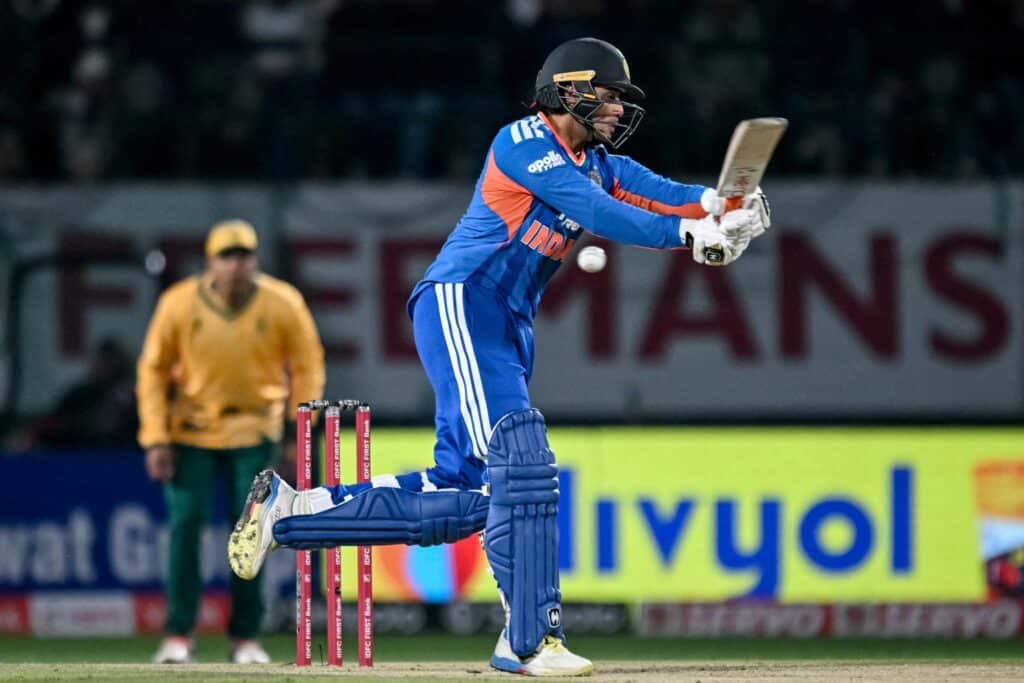
Record-Breaking Powerplay Assault: 92 Without Loss
The moment New Zealand captain Mitchell Santner won the toss and chose to field, the Sanju Samson and Abhishek Sharma opening partnership began rewriting history. After a cautious first couple of overs where they assessed conditions, the duo unleashed an assault that left the Kiwi bowlers shell-shocked and searching for answers.
According to ICC’s official match coverage, the opening pair plundered 92 runs in the first six overs without losing a wicket, equaling the joint-highest powerplay score in T20 World Cup history. The carnage was methodical yet brutal, with both batters finding boundaries at will against pace and spin alike.
The fourth over bowled by Matt Henry proved particularly expensive, with the batters clobbering 24 runs as the bowler lost his composure and line. The usually reliable Kiwi paceman conceded four wides in the fifth over alone, contributing to eight extra deliveries New Zealand bowled during the powerplay – their most ever in T20 international cricket.
Sanju Samson and Abhishek Sharma became the first opening partnership to register a fifty-plus stand in any men’s T20 World Cup final, surpassing the previous record of 48 runs between Pakistan’s Kamran Akmal and Shahzaib Hasan against Sri Lanka at Lord’s in 2009. Their partnership gave the defending champions exactly the explosive start they needed on the biggest stage.
Lockie Ferguson suffered particularly harsh treatment, conceding 24 runs in just one over as both openers took turns smashing him to all parts of the ground. Ferguson finished with figures of two overs for 48 runs, an economy rate that speaks to the sheer dominance displayed by the batters.
The capacity crowd of over 130,000 fans at the world’s largest cricket stadium created an electric atmosphere that lifted the home team. Every boundary was cheered, every dot ball applauded, as the 12th man played their part magnificently.
Sharma Silences Critics with Explosive Fifty
Heading into the final, Abhishek Sharma faced immense scrutiny. The world number one ranked T20I batter had managed just 89 runs from seven innings at the tournament, with 55 of those coming in a single knock against Zimbabwe. Calls for his exclusion from the playing eleven grew louder after each failure, with former players suggesting alternatives.
But Sanju Samson and Abhishek Sharma both believed this would be his day, and the left-hander delivered spectacularly when it mattered most. He raced to his half-century in just 18 balls with the help of six fours and three sixes, registering both the fastest fifty in any T20 World Cup knockout match and the quickest of the entire tournament.
The innings was a masterclass in aggressive intent from ball one. After playing out the only over of off-spin bowled upfront by Glenn Phillips, Sharma took on the Kiwi pacers with calculated ferocity. He walked across his stumps repeatedly, pulling deliveries into the leg side even when bowlers tried bowling wide slower balls with two boundary riders on the off side.
His approach demonstrated remarkable courage under pressure. Rather than playing conservatively to protect his spot, he attacked from the outset, trusting his ability and backing his strengths exactly as teammate Samson had predicted he would. Samson had expressed confidence before the match, saying “we feel that the final is going to be his day” and predicting Abhishek would “come really great on the last day”.
The youngster’s innings ended in the eighth over when Rachin Ravindra provided New Zealand their first breakthrough, having Sharma nick one to the wicketkeeper after his blazing 52 off 20 deliveries. He walked off to a standing ovation, having silenced critics and delivered exactly when his team needed him most.
Samson’s Tournament Continues Its Magic
If Abhishek Sharma’s fifty answered questions about his form, Sanju Samson and Abhishek Sharma’s partnership demonstrated why the Kerala wicketkeeper-batsman has been the tournament’s standout performer. Samson continued his sensational run, crafting another masterful innings that had opposition bowlers scrambling for solutions.
Samson finished with 89 runs off just 46 deliveries, an innings studded with five fours and eight sixes that showcased his full range of strokes. His strike rate of 193.47 maintained the tempo even after Sharma’s dismissal, ensuring no momentum was lost during the middle overs.
The opener particularly targeted Rachin Ravindra, smashing three consecutive sixes off the left-arm spinner in one memorable over that had the crowd on its feet. His ability to pick length early and execute shots with precision made him virtually unstoppable throughout the powerplay and middle overs.
This represented Samson’s third consecutive half-century in the tournament, having previously scored 97 not out against West Indies and 89 against England in the semi-final. He earned Player of the Match awards in both those knockout victories, his exceptional performances proving crucial in guiding the defending champions into the final.
Former India coach Ravi Shastri credited Samson’s mental toughness for his recent success. Shastri noted that Samson has “toughened up mentally” and is now backing his strengths rather than getting out through lapses in concentration as he sometimes did earlier in his career.
Captain Suryakumar Yadav acknowledged the decision to include Samson in the playing eleven as pivotal to the team’s tournament success. The skipper revealed that bringing Samson into the lineup was key, as combinations like Abhishek, Sanju, and Ishan at the top had been working well in recent bilateral series.
Samson’s innings ended in the 16th over when James Neesham had him caught attempting to hit a full toss, with the batter unable to find the gap as he tried to accelerate further. His dismissal came at 203 for two, leaving the middle order to finish the job.

Middle Order Contributions: Building on the Foundation
With Sanju Samson and Abhishek Sharma having laid a phenomenal platform, the middle order faced the challenge of maintaining momentum while building toward a total that would put the match beyond New Zealand’s reach. Ishan Kishan walked in after Sharma’s dismissal and wasted no time settling in.
Kishan played his natural aggressive game, contributing valuable runs in partnership with Samson before falling in the same Neesham over that claimed both Samson and captain Suryakumar Yadav, with Rachin Ravindra taking a brilliant catch to dismiss the skipper. That triple-wicket over briefly slowed the scoring rate.
From a commanding 203 for two, the defending champions slipped to 204 for four in the space of just one over as Neesham struck three times. The momentum shift created tension in the stadium, with fans suddenly concerned about whether the total would reach the projected 250-plus mark.
Tilak Varma and Hardik Pandya steadied the innings briefly, but Pandya struggled for timing throughout his cameo, managing 18 off 12 balls before skying a well-directed slower bouncer from Matt Henry. The experienced all-rounder’s dismissal left just two overs remaining with the total still below 240.
New Zealand appeared to have clawed back control, with bowlers executing their plans better and fielders saving boundaries through excellent efforts. The hosts managed just 17 runs off three overs during this period, raising concerns they might finish below 240 when 300 had seemed possible earlier.
However, championship teams find ways to finish strong, and Shivam Dube ensured exactly that. Coming in with pressure mounting, the left-hander produced exactly the cameo required in the circumstances.
Final Over Fireworks: Dube’s Match-Defining Assault
The final over of the innings belonged entirely to Shivam Dube, who produced one of the most destructive closing overs in T20 World Cup history. Facing Matt Henry, who had been New Zealand’s best bowler with figures of one wicket for 44 runs from his first three overs, Dube unleashed carnage.
Dube smashed 24 runs off the final over, plundering three fours and two sixes to finish with 26 off just eight deliveries and propel the total past the 250-mark. His assault completely changed the complexion of the total, transforming what looked like 240 into a daunting 255.
The left-hander’s timing was impeccable, finding gaps with precision and clearing boundaries with ease. Each shot was met with thunderous applause from the partisan crowd, who sensed their team was posting a potentially match-winning total. Just when it appeared New Zealand had pulled things back, Dube’s world-class hitting ensured the defending champions finished with momentum.
The final total of 255 for five represents the highest score ever posted in a T20 World Cup final, surpassing all previous records. It also marked the third time in the tournament that the hosts had crossed 250, demonstrating their consistent ability to post huge totals when batting first.
The innings featured 19 fours and 18 sixes, with boundary-hitting accounting for 184 of the team’s 255 runs. That statistic showcases the aggressive approach employed throughout, with batters consistently looking for boundaries rather than settling for singles and twos.
New Zealand now face the challenge of chasing 256 runs to win their maiden ICC trophy. No team has successfully chased down a target this large in T20 World Cup history, though the pitch appears excellent for batting. The Kiwis will need their best batting performance of the tournament to overcome this mountain.
For the defending champions, the target represents validation of their aggressive batting philosophy. They’ve trusted their batters to take risks, and Sanju Samson and Abhishek Sharma delivered magnificently in the biggest match of all. Now their bowlers must defend this total and complete the historic achievement of becoming the first team to win back-to-back T20 World Cups.
Statistical Milestones and Records Broken
The first innings of this T20 World Cup final shattered numerous records and created several new benchmarks in tournament history. The opening partnership between Samson and Sharma became the first fifty-plus stand by any opening pair in a men’s T20 World Cup final, breaking the previous record of 48.
The team reached 100 runs in just 7.2 overs, recording the fastest team century in T20 World Cup knockout history. That milestone demonstrated the relentless aggression displayed from the very first over, with both openers refusing to give bowlers any respite.
The team’s powerplay score of 92 runs also equals the highest powerplay total in any T20 World Cup match and represents a new record for the fastest team fifty in a World Cup final, achieved in just four overs. Those early overs set the template for everything that followed.
Individual milestones were equally impressive. Abhishek Sharma’s 18-ball fifty equaled the record for fastest in T20 World Cup knockouts and stood as the quickest of the entire tournament. His redemption story – from struggling through seven innings to delivering spectacularly in the final – will inspire cricketers for years to come.
Samson’s 89 continued his remarkable tournament form. He became only the second Indian batsman after Virat Kohli to score back-to-back fifties in T20 World Cup matches, joining elite company with his consistent brilliance.
The total of 255 for five surpassed the previous T20 World Cup final record by a considerable margin, establishing a new benchmark for batting excellence on the sport’s biggest stage. Whether this total proves defendable remains to be seen, but the batting display will be remembered regardless of the final result.
Final Thoughts on a Batting Masterclass
The first half of this T20 World Cup final delivered everything fans could hope for – explosive batting, record-breaking partnerships, individual brilliance, and enough drama to keep spectators on the edge of their seats throughout. Sanju Samson and Abhishek Sharma provided the foundation with their spectacular opening stand, then Dube ensured a strong finish that maximized the total.
For Abhishek Sharma, this innings represented redemption and vindication. Despite calls for his exclusion and struggles throughout the tournament, he trusted his ability and delivered spectacularly when it mattered most. His 52 off 20 balls answered every critic and proved why the team management kept faith in him.
For Sanju Samson, this was simply another chapter in a tournament where he’s been the standout performer. His three consecutive match-winning knocks in knockout matches showcase a player peaking at exactly the right moment, delivering when the pressure is highest and the stakes are greatest.
Now attention turns to New Zealand’s chase. Can they pull off the greatest run chase in T20 World Cup history, or will the defending champions’ bowlers defend this mountain of runs and complete their historic title defense? The answer awaits in the second innings.
Related Reading:
External Resources: